
Permanent Lip Tint vs Lip Blush | What’s the Difference?

Reviewed by Dr. Shalthiel Sathe
Last updated: November 16 2026
Table of Contents
Table of Contents
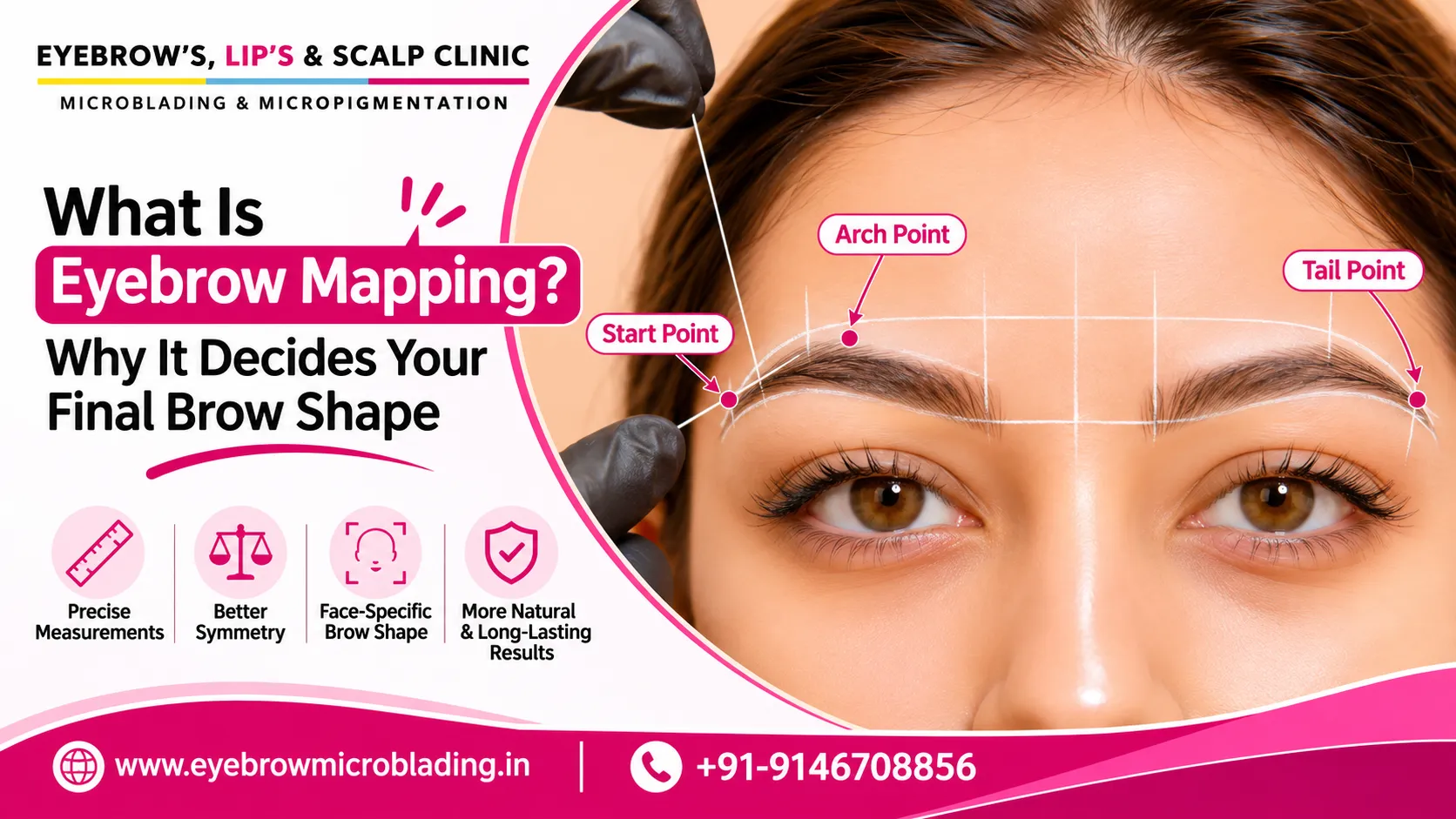
What Is Eyebrow Mapping? Why It Decides Your Final Brow Shape
If you’ve ever looked in the mirror after a brow appointment and thought “why does one eyebrow look higher than the other,” the answer almost always traces back to one step: mapping. It’s the part of the appointment that happens before the exciting part before any pigment, before the machine or blade comes out and it’s also the part that decides whether you walk out thrilled or walk out googling “how to fix uneven eyebrows.”
This article explains exactly what eyebrow mapping is, how it’s actually done and why it deserves far more of your attention than most people give it before booking a microblading or ombre brow appointment.
Quick Summary: Eyebrow mapping is the measurement and marking process a PMU artist uses to plan your brow shape before any pigment or blade touches your skin. Using facial landmarks typically based on golden-ratio proportions the artist marks a start point, arch point, and tail point for each brow, then draws the outline that’s actually followed during microblading, ombre powder brows, or combo brows.
What Is Eyebrow Mapping?
Eyebrow mapping is the process of measuring and marking your face to design a brow shape that’s balanced, symmetrical, and suited to your bone structure before any permanent pigment is applied. A trained PMU artist uses measuring tools (a brow pencil, calipers, or thread/string) to identify where your brows should ideally start, arch, and end, based on the position of your nose, eyes, and the natural angles of your face.
Think of it as architecture, not art at least at this stage. The “artistic” part (hair-stroke texture, shading, colour) comes later. Mapping is the math that makes sure that art has the right foundation to sit on.
Here’s the part most people don’t realise until it’s too late: once pigment is implanted, the shape is locked in for months to years. Unlike eyebrow pencil or threading, you can’t just wipe it off and redo it tomorrow. This is exactly why mapping not the pigmenting technique, not even the artist’s hand-stroke skill is the single most consequential step in the entire process.
A few reasons mapping has this much influence over your result:
- It sets the boundaries everything else works within. Even the most skilled hand-stroke or shading work can’t fix a start point that’s too close to the nose or an arch that’s in the wrong place the artist is simply filling in a shape that’s already been decided.
- It’s your last real chance to adjust before commitment. A good artist will show you the mapped-out shape, let you see it in a mirror, and get your approval before moving forward this is the moment to speak up, not after.
- It accounts for asymmetry you may not even notice. Almost everyone’s face is naturally a little asymmetrical. Mapping is what allows an artist to compensate for this rather than mirror an uneven feature on both sides.
- It’s what separates a “studio look” from a bought-off-the-shelf shape. Two people with similar natural brows can need noticeably different shapes once their individual bone structure is actually measured.
The Key Measurement Points: Start, Arch, and Tail
Professional brow mapping is typically built around three landmark points per brow, often based on golden-ratio facial proportions:
- Start point — found by aligning a straight edge from the outer edge of the nostril straight up to the inner corner of the eye. This marks where the brow should begin.
- Arch point — found by angling the tool from the edge of the nostril through the center of the iris (when looking straight ahead). This marks the highest point of the brow’s arch.
- Tail/end point — found by angling the tool from the edge of the nostril to the outer corner of the eye. This marks where the brow should end.
Connecting these three points on each side gives the artist the outline to design within. The underlying idea using the golden ratio for facial balance isn’t new-age beauty talk; it’s a long-used principle of visual proportion applied specifically to where a brow “should” sit relative to your own eyes and nose, not a generic template copied from someone else’s face.
Tools Used in Professional Eyebrow Mapping
A proper mapping session typically uses some combination of:
- Brow mapping string or thread — often chalk-coated or pre-inked, stretched and snapped lightly against the skin to leave a straight reference line
- Calipers — for precise, repeatable measurements, especially comparing both sides for symmetry
- A brow pencil or marker — for the final visible outline the client reviews and approves
- A mirror — handed to the client at this stage specifically so they can see and react to the shape before anything is permanent
If an artist skips straight to drawing free-hand without using any reference measurement at all, that’s worth asking about — it doesn’t automatically mean a bad result, but it removes the built-in symmetry check that proper mapping provides.
Eyebrow Mapping Procedure
- Consultation first — The artist discusses your preferred shape, shows you reference photos or their own portfolio and sets realistic expectations based on your natural brow hair and bone structure
- Eyes closed, face relaxed — Mapping is done with your eyes closed and facial muscles relaxed, because an engaged or squinting expression subtly shifts brow position and produces an inaccurate map
- Measuring and Marking — The artist identifies the start, arch, and tail points using string, calipers, or a pencil, for both brows independently
- Drawing the outline — The points are connected into a full brow outline, adjusted for your face shape and any natural asymmetry
- Client review — You open your eyes and look in the mirror. This is your moment to ask for adjustments, a slightly higher arch, a longer tail, more or less space between brows before anything is permanent
- Final approval, then numbing and procedure — Only once you’ve approved the shape does the artist move on to numbing and the actual pigmenting technique (microblading, ombre, or combo)
Plan for this step to take roughly 20–40 minutes on its own, within a full appointment that typically runs 2–3 hours including numbing and the procedure itself. If an artist maps your brows in under five minutes without showing you a mirror first, that’s a reasonable moment to pause and ask questions.
Eyebrow Mapping and Face Shape
While the start/arch/tail landmarks are the foundation, an experienced artist also adjusts the final shape based on your face shape and features:
- Round faces often benefit from a slightly angled arch to add definition
- Long faces often suit a flatter, more horizontal brow to avoid adding visual length
- Square faces often pair well with a softly curved brow to balance strong jaw angles
- Heart-shaped faces often suit a softer arch that doesn’t compete with a narrower chin
Mapping gives the mathematical foundation; face-shape judgment is where an experienced artist’s eye still matters on top of the measurements.
Common Eyebrow Mapping Mistakes
- Mapping with eyes open produces a map based on an unnaturally engaged brow position, leading to shapes that look “off” once your face relaxes
- Rushing the process mapping properly takes time; a five-minute mapping session on a 2–3 hour appointment is a red flag, not efficiency
- Not showing the client a mirror before proceeding removes your one real opportunity to request changes before pigment is applied
- Copying a reference photo exactly rather than adapting it to the client’s actual bone structure a shape that looks great on someone else’s face can look wrong on yours
- Skipping measurement tools entirely and free-handing the shape removes the built-in symmetry check that string/caliper measurement provides
- Letting client or companion pressure override the artist’s professional judgment — a shape requested against the artist’s recommendation (e.g., too thin, too high) often ages into regret once the pigment settles
Why Mapping Matters Even More for Permanent Techniques
Mapping matters for brow grooming generally, but its importance multiplies for semi-permanent and permanent techniques — microblading, ombre powder brows, and combo brows for one simple reason: the margin for error disappears. A bad wax or tint grows out or fades in weeks.
A mapping mistake on a microbladed or ombre brow is living with an asymmetrical or miscalculated shape for 12 months to 3 years before it fades enough to correct. This is exactly why the mapping consultation deserves as much scrutiny from you, as a client, as the artist’s portfolio of finished results.
Why Choose Eyebrows, Lips & Scalp Clinic for Brow Mapping in Pune
Eyebrows, Lips & Scalp Clinic is led by Dr. Shalthiel Sathe, an internationally certified PMU artist over 11 years of experience in micropigmentation and clinical cosmetology. Mapping isn’t treated as a quick formality here it’s a dedicated step in every eyebrow appointment, done with measurement tools, not guesswork, and always reviewed with the client before any pigment is applied.
Benefits of Brow Mapping Eyebrows Lips & Scalp Clinic:
- A real measurement-based mapping process (string/caliper-guided), not free-hand estimation
- A mirror-check and approval step built into every appointment, before numbing begins
- Face-shape and bone-structure judgment layered on top of the mathematical mapping
- The same precision standard applied across microblading, ombre powder brows, combo brows, and nano brows
Clinic details:
- Besides Chirayu Hospital, Aabai Tower, Flat No. 203, 2nd Floor, Datta Mandir Road, Shankar Kalat Nagar, Wakad, Pune
- Phone: +91-9146708856
- Hours: Open Monday–Sunday, 11:00 AM – 8:00 PM
Conclusion
Eyebrow mapping is the quiet, unglamorous step that nobody posts about on Instagram — but it’s the one that actually determines whether your finished brows look balanced and natural, or need correcting later. Before booking any microblading, ombre, or combo brow appointment, ask how the studio approaches mapping, not just what the finished results look like. If you’re in Pune and want brows planned with real measurement and a proper mirror-check before anything is permanent, book a consultation with Eyebrows, Lips & Scalp Clinic in Wakad
Frequently Asked Questions
What is eyebrow mapping?
Eyebrow mapping is the measurement and marking process a PMU artist uses to design your brow shape — identifying the ideal start, arch, and tail points based on your facial features — before any pigment or blade touches your skin.
Why is eyebrow mapping important before microblading?
Because once pigment is implanted, the shape is locked in for months to years. Mapping is your last chance to review and adjust the shape, and it’s what ensures both brows come out balanced and symmetrical rather than mismatched.
How is eyebrow mapping done?
An artist uses tools like brow mapping string, calipers, or a pencil to find three landmark points per brow — the start point, arch point, and tail point — typically based on golden-ratio facial proportions, then connects them into a full outline for your approval.
Is laser removal safe on microblading?
Because once pigment is implanted, the shape is locked in for months to years. Mapping is your last chance to review and adjust the shape, and it’s what ensures both brows come out balanced and symmetrical rather than mismatched.
How is eyebrow mapping done?
An artist uses tools like brow mapping string, calipers, or a pencil to find three landmark points per brow — the start point, arch point, and tail point — typically based on golden-ratio facial proportions, then connects them into a full outline for your approval.
How long does eyebrow mapping take?
Proper eyebrow mapping typically takes 20 to 40 minutes on its own, as part of a full appointment that usually runs 2 to 3 hours including numbing and the actual pigmenting procedure.
What is the golden ratio in eyebrow mapping?
The golden ratio is a principle of visual proportion used to calculate where a brow should ideally begin, arch, and end relative to the position of your own nose and eyes — not a single fixed shape applied to everyone the same way.
Can eyebrow mapping be wrong?
Yes. Common mistakes include mapping with the eyes open, rushing the process, skipping measurement tools, or not showing the client a mirror before proceeding — any of which can lead to an uneven or miscalculated final shape.