
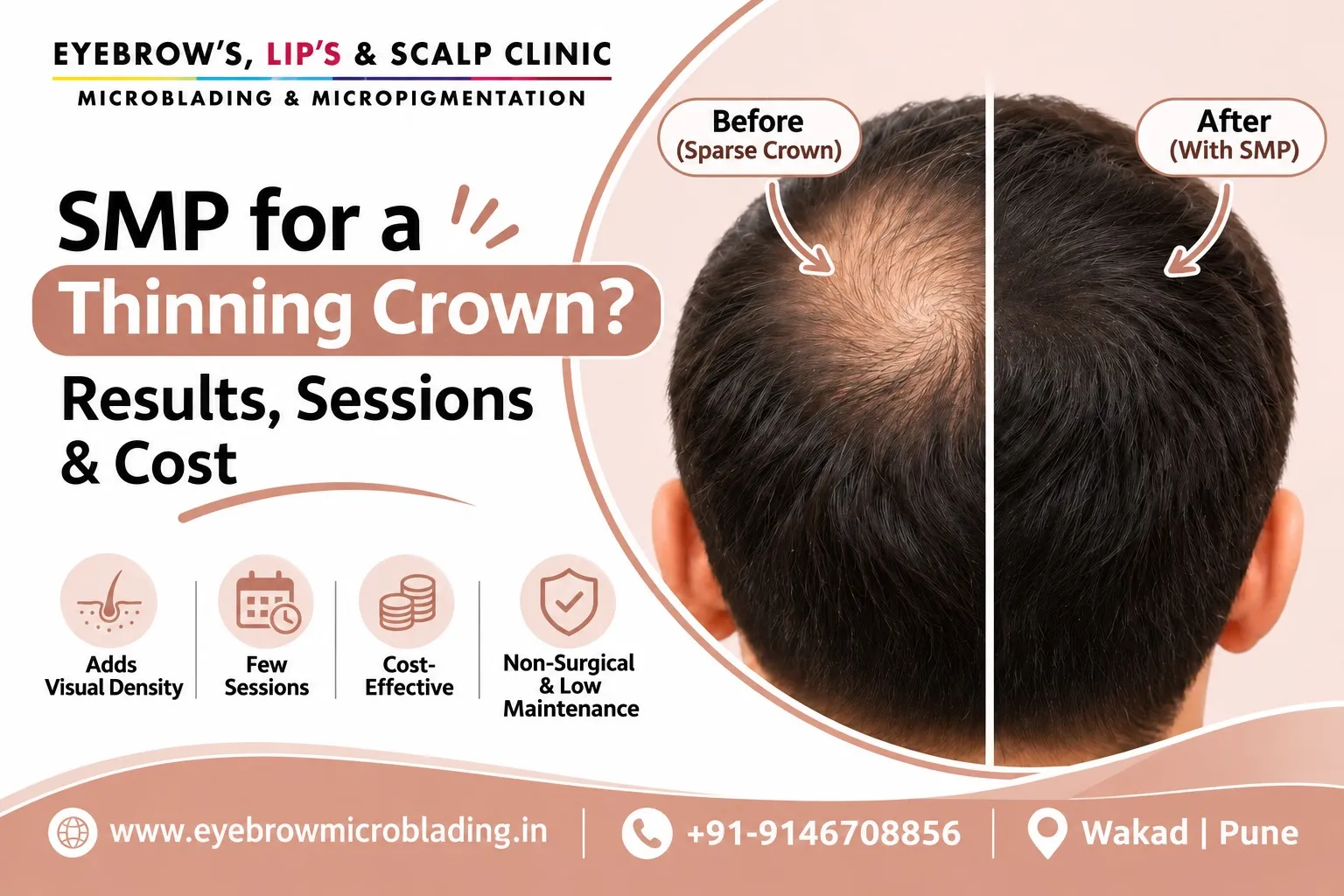
SMP for a Thinning Crown: Results, Sessions & Cost

Reviewed by Dr. Shalthiel Sathe
Last updated: November 23 2026
Table of Contents
SMP for a Thinning Crown: Results, Sessions & Cost
Crown thinning has a way of sneaking up on people. You can check your hairline in the mirror every morning, but the crown is the one spot you genuinely can’t see without a second mirror or a slightly awkward phone photo which is usually how most people actually discover it, often because someone else mentioned it first.
If you’re reading this because that’s exactly what happened to you, here’s the good news: the crown is one of the areas scalp micropigmentation handles best, specifically because it can blend new density into hair you still have, rather than starting from a shaved scalp.
This article covers how SMP for the crown actually works, how many sessions it takes, what it costs in Pune, and where it has real limits.
Quick Summary: Scalp micropigmentation (SMP) for a thinning crown uses tiny, hair-follicle-like pigment deposits to rebuild the look of density in a specific area the vertex/crown rather than treating the whole head. It’s the go-to option for crown thinning because it blends in with your existing surrounding hair rather than requiring a shaved look.
What Is SMP for a Thinning Crown?
Scalp micropigmentation is a cosmetic tattooing technique where a trained practitioner deposits tiny, pigment dots into the scalp’s upper dermal layer, mimicking the look of hair follicles. For a thinning crown specifically, the technique is applied within and around your existing hair rather than across a fully shaved head the goal is to fill in the visible scalp showing through thinning hair so the overall area reads as denser, not to create a buzzed, fully pigmented look.
This distinction matters because crown thinning is rarely “bald” in the way a hairline recession can look — it’s usually diffuse thinning where hair is present but sparse enough that scalp shows through, especially under bright light or in photos. SMP is specifically well-suited to this pattern.
It’s important to be upfront about what this treatment does and doesn’t do:
- It can make thinning crown hair look visibly denser and more even-toned
- It can camouflage the scalp-show-through that makes thinning most noticeable in photos and bright light
- It does NOT regrow hair or stop ongoing hair loss
- It is NOT a substitute for a dermatologist’s evaluation if your hair loss is progressive or has an underlying medical cause
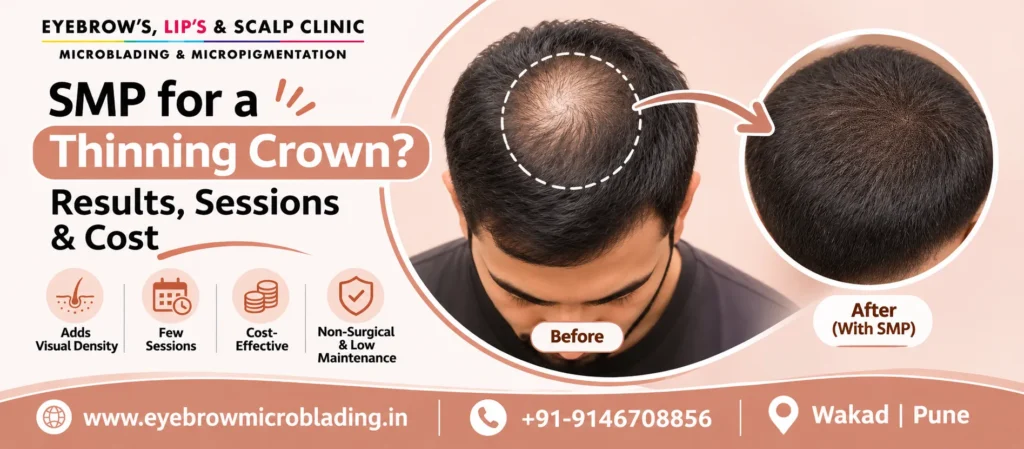
The crown (vertex) is one of the most common sites for androgenetic hair loss in men, and a frequent site of diffuse thinning in women, for a few structural reasons:
- Hormonal sensitivity — crown hair follicles are often more sensitive to DHT (a hormone linked to pattern hair loss) than hair at the sides and back of the head
- It’s a growth-pattern whorl — hair at the crown naturally grows in a spiral/whorl pattern, which can make early thinning more visually obvious as the part widens outward
- It’s the hardest area to self-monitor — because you can’t see it directly, crown thinning is often noticed later than a receding hairline, by which point it may be more advanced
- It thins independently of the hairline — it’s entirely possible to have a strong hairline and a thinning crown at the same time, or vice versa
Understanding why your crown is thinning (genetics, hormonal, age-related, stress-related, or a medical condition) matters for choosing the right approach which is why a proper consultation, and a dermatologist’s input where appropriate, should always come before committing to any cosmetic treatment.
Is SMP Right Treatment for a Thinning Crown?
SMP tends to be good for crown thinning when:
- You have diffuse thinning with hair still present, not a fully bald patch — SMP pigment blends between existing strands to reduce scalp show-through
- You want a low-maintenance, non-surgical option rather than ongoing medical treatments or a transplant
- You’re not planning to grow your hair long over the crown area, since SMP is optimized to look best with shorter hair lengths
- You want results immediately visible, without the months-long wait that hair growth treatments or transplants require
A technical note worth knowing: the skin at the crown is structurally thinner than at the sides of the scalp, which means a skilled practitioner needs to adjust needle depth and technique specifically for this area treating the crown exactly like the rest of the scalp can lead to less precise, less natural-looking results.
SMP for Crown Vs Other Treatment Options
| SMP | Hair Transplant | PRP Therapy | Fibers/Concealers |
What it does | Cosmetically camouflages thinning | Surgically relocates real hair follicles | May stimulate existing follicles | Temporarily adds visual thickness |
Grows real hair? | No | Yes | Sometimes, partially | No |
Downtime | Minimal (days) | 1–2 weeks | None to minimal | None |
Results visible | Immediately after healing | 6–12 months | Several months, variable | Instantly, but washes out |
Typical longevity | 3–5 yrs before touch-up | Permanent (transplanted hair) | Requires ongoing sessions | Daily reapplication |
Best suited for | Diffuse thinning or fully bald areas | Sufficient donor hair, surgical candidates | Early-stage thinning, as a complement | Quick, temporary fixes |
As one hair-restoration source puts it plainly: “SMP changes how your scalp looks; a transplant changes what your scalp grows.” Neither SMP nor a transplant stops the underlying progression of pattern hair loss on its own which is why many people combine SMP with a dermatologist-guided medical treatment (like minoxidil or finasteride, where appropriate) rather than treating it as a complete solution by itself.
How Many Sessions Does Crown SMP Take?
Most crown SMP treatments are completed in 2 to 4 sessions, each typically lasting 2 to 4 hours, spaced roughly 1 to 3 weeks apart. The exact number depends on:
- How large an area the thinning covers
- How much pigment density is needed to match your natural hair colour and density
- How your skin holds and settles the pigment after the first session
Because a thinning crown is usually a smaller, more contained area than a fully bald scalp, it often requires fewer sessions and less total pigment than a full-head treatment though this should always be confirmed at your consultation rather than assumed.
Cost of SMP for a Thinning Crown in Pune
Pricing for scalp micropigmentation in Pune typically falls in the ₹25,000–₹40,000 range for a full treatment course, based on current clinic pricing in the city. For a thinning crown specifically a smaller, partial-area treatment compared to a full scalp cost typically sits toward the lower end of this range, since the main price drivers are treatment area, number of sessions, and practitioner expertise.
What Affects Your Final Price:
- Size of the thinning area — a contained crown patch costs less than full-scalp coverage
- Number of sessions needed — determined at consultation based on density required
- Practitioner experience — crown work in particular benefits from an experienced hand, given the area’s thinner skin
- Touch-up schedule — most clinics recommend periodic touch-ups as pigment naturally softens over years
Always get an exact quote at an in-person consultation rather than relying on general ranges a proper assessment of your specific thinning pattern is what determines real pricing, not a one-size-fits-all number.
Healing Timeline: Week by Week
- Day 1: Keep the area completely dry for 24–48 hours; avoid lotions unless specifically prescribed, and avoid sweating
- Week 1: Micro-scabs form; mild itching, flaking, and a temporarily darker pigment appearance are normal. Avoid direct sun and sweating.
- Week 2: Scabbing subsides and the pigment colour softens to a more natural tone. Avoid swimming and very hot showers.
- Week 3: A touch-up session may be scheduled here if your treatment plan calls for one
- Week 4: Healing is nearly complete; use SPF 30+ on the area when outdoors, since sun exposure is the leading cause of premature fading
- Weeks 5–6: Fully healed; switch to a mild, sulfate-free shampoo going forward, and expect to revisit for a touch-up roughly once a year or as recommended
Results: What to Expect and How Long They Last
Results are typically visible progressively across sessions, with the final blended look confirmed once all healing is complete (around week 5–6). Most people see results lasting 3 to 5 years before a touch-up is needed to refresh colour and density, though this varies with skin type, sun exposure, and how well aftercare is followed some well-placed work can last considerably longer, while fading can occur sooner with heavy sun exposure or lower-quality pigment.
One honest limitation worth repeating: SMP does not grow hair or change your natural hair growth pattern. If your crown continues to thin naturally after treatment, the surrounding hair density may change relative to the pigmented area over time, which is part of why periodic touch-ups and reassessment are a normal part of long-term SMP maintenance, not a sign of a failed procedure.
Why Choose Eyebrows, Lips & Scalp Clinic for Crown SMP in Pune
Eyebrows, Lips & Scalp Clinic is led by Dr. Shalthiel Sathe, an internationally certified PMU artist over 11 years of experience in micropigmentation and clinical cosmetology, including scalp micropigmentation for men and women across different stages and patterns of thinning.
What this means for you:
- A proper consultation assessing your specific crown thinning pattern before any pigment is applied
- Technique adjusted for the crown’s thinner skin rather than a one-size-fits-all approach
- Medical-grade, hypoallergenic pigments used in a sterile clinical setting
- Honest guidance on what SMP can and can’t do for your specific case, including when a dermatologist referral makes sense first
Clinic details:
Besides Chirayu Hospital, Aabai Tower, Flat No. 203, 2nd Floor, Datta Mandir Road, Shankar Kalat Nagar, Wakad, Pune
Phone: +91-9146708856
Hours: Open Monday–Sunday, 11:00 AM – 8:00 PM
Conclusion
A thinning crown is one of the most common and most cosmetically treatable hair concerns, precisely because SMP can blend new density into the hair you still have rather than requiring a shaved-head look.
It won’t regrow hair or halt underlying hair loss, but for camouflaging crown show-through with minimal downtime, it’s one of the most reliable options available today. If you’re in Pune and want an honest assessment of your crown thinning pattern and a realistic session and cost plan, book a consultation with Eyebrows, Lips & Scalp Clinic in Wakad
Frequently Asked Questions
What is SMP for a thinning crown?
SMP (scalp micropigmentation) for a thinning crown deposits tiny, hair-follicle-like pigment dots within and around existing hair at the vertex to reduce scalp show-through and create the appearance of denser hair, without requiring a shaved-head look
How much does SMP for a thinning crown cost in Pune?
Full scalp micropigmentation treatments in Pune typically cost ₹25,000–₹40,000. A thinning crown, being a smaller, partial-area treatment, usually falls toward the lower end of this range, though exact pricing depends on area size and sessions needed, confirmed at consultation.
How many sessions does SMP for the crown take?
Most crown SMP treatments take 2 to 4 sessions, each lasting around 2 to 4 hours, spaced 1 to 3 weeks apart. Crown treatments often need fewer sessions than a full-scalp treatment since the area is smaller.
Does SMP regrow hair on a thinning crown?
No. SMP is a cosmetic camouflage technique that creates the visual appearance of density — it does not regrow hair or stop underlying hair loss. For actual hair regrowth, a dermatologist can advise on medical treatment options separately.
How long do SMP results last on the crown?
Results typically last 3 to 5 years before a touch-up is needed to refresh colour and density, though this varies with skin type, sun exposure, and pigment quality. Some well-placed work can last longer with good aftercare.
Is SMP better than a hair transplant for crown thinning?
Neither is universally better — they solve different problems. SMP cosmetically camouflages thinning with minimal downtime and immediate results, while a hair transplant surgically relocates real, growing hair but requires more downtime and months to show full results.
Is SMP safe for the crown area?
Yes, when performed by an experienced practitioner using sterile, medical-grade pigments. The crown’s skin is thinner than other scalp areas, so technique needs to be adjusted — this makes practitioner experience with crown-specific work especially important.
Who should avoid SMP for crown thinning?
SMP isn’t recommended for those with active scalp conditions (like unstable psoriasis or eczema), known pigment allergies, a tendency toward keloid scarring, or rapidly progressing hair loss that hasn’t been evaluated by a dermatologist first.